CONFESION: Is it scriptural?
- Glendaliz Gonzalez

- Feb 17, 2020
- 7 min read
Why must we confess our sins to a priest? Is it not enough to confess them directly to God?
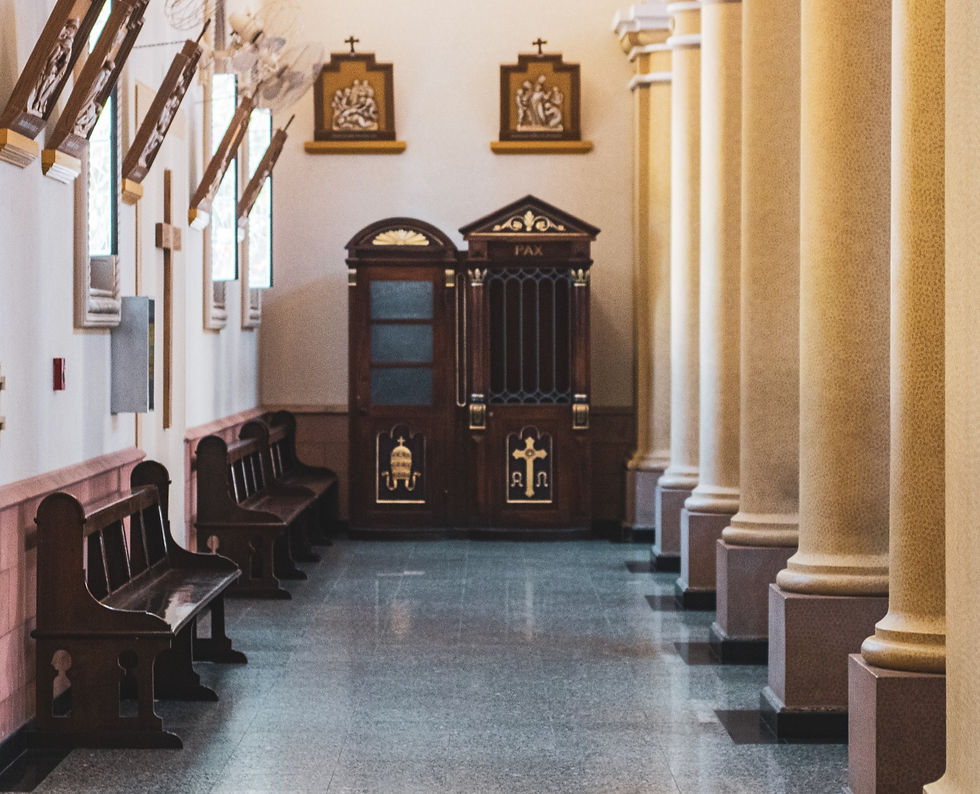
Let's start by clearing up a major misconception. Catholics do not tell their sins to a priest instead of to God. We confess our sins first to God and God forgives us through a priest which is appointed by our Lord as an official stand-in for Christ (alter Christus).
Three basic Scripture passages underlie this practice:
"And so I say to YOU, YOU are Peter [instant change of name from Simon], and upon this rock I will build my church, and the gates of hell shall not prevail against it. I will give YOU [Peter] the keys to the kingdom of heaven. Whatever YOU [Peter] bind on earth shall be bound in heaven; and whatever YOU [Peter] loose on earth shall be loosed in heaven." Matthew 16:18-19
God revealed a new and radical calling to an individual. This happened every time he changed someone’s name in scripture. This is very significant and often overlooked. Jesus could have kept Peter’s name as Simon but didn’t because his calling was beyond that of his birth given name. We see this with Abram-Abraham and Jacob-Israel.
Jesus uses the word you seven times in just three verses. It doesn’t follow that Jesus would address so much of this passage to Peter, and then say, “But I will build my Church upon me.” The context is clearly one in which Jesus is communicating a unique authority to Peter. Jesus is “the wise man who built his house upon the rock” (Matthew 7:24) Making Jesus the builder of the Church, not the building. He said, “I will build my church.” Jesus building the Church upon himself does not fit the context.
"Amen, I say to YOU, whatever YOU [Peter] bind on earth shall be bound in heaven, and whatever YOU [Peter] loose on earth shall be loosed in heaven." Matthew 18:18
Jesus said to THEM [the apostles] again, "Peace be with you. As the Father has sent me, so I send you [the apostles]." And when he has said this, he breathed on them [the apostles] and said to them [the apostles], "Receive the holy Spirit. Whose sins YOU [the apostles] forgive are forgiven them, and whose sins YOU [the apostles] retain are retained." John 20:21-22
Now lets not pretend that the text isn't clear as day here. The authority he gave here was not to all of his disciples which at the time were in the thousands, but to his twelve most trusted apostles.
He gave Peter the keys to the kingdom. I know many argue that the ‘rock’ Jesus spoke of in this text meant himself. Although the New Testament was written in Greek due to the fact that it was the main language spoken in Rome at the time, it is undeniable that this was not the language actually spoken by Jesus. Araimaic was the language spoken by the Jews. Hence, the name used in Aramaic in this verse is “Cephas” which means "rock". The apostle Simon was called Cephas by Jesus because he was to be the rock upon which the Christian church was to be built. In most versions of the New Testament Cephas is translated into Greek Πετρος (Petros) (in English Peter).
There’s no big rock/little rock and that idea definitely isn't taught in scriptures. As Protestants believe in Scripture ALONE, this is one thing that isn’t taught here. If it were so, the Greek word for ‘little rock” would be specified on that verse. In Koine Greek (the dialect used by the authors of the New Testament), petros and petra are the masculine and feminine form of a word with the same root and the same definition—”rock.” Therefore, there is no “small rock” in the Greek text either.
The ‘little rock” theory came less than 500 years ago and early Christians believed that Peter is the Rock Jesus referred to in Matthew 16:18 for over 1500 years. There is also biblical evidence, in John 1:42, that Jesus used Aramaic in the naming of Peter:
[Andrew] brought [Peter] to Jesus. Jesus looked at him and said, “So you are Simon the son of John? You shall be called Cephas” (which means Peter).
Many Protestants believe the two “rocks” in the Greek text have different meanings: “Thou art Petros, and on this petra I will build my church.” They believe Petros, the first “rock,” refers to a small rock (Peter) and petra, the second “rock,” means a massive boulder—either Jesus or Peter’s confession of faith. Thus the argument concludes that Jesus did not build his Church upon Peter but upon either himself or Peter’s faith.
Question: Why did Matthew specify two different words for rock in the same sentence?
I’m glad you asked! Here is why…
Petra: Common word for Rock in Greek and used over fifteen times throughout the New Testament to mean “rock,” “rocks,” or “rocky” in the New Testament. However, it is a feminine noun which is why evidently it couldn’t use it for Peter as it would've been improper to do so.
Petros: Is an ancient Greek term that was not commonly used in Koine Greek. It was never otherwise used in the New Testament except when Jesus changed Peter’s name from Simon to Peter.
Peter himself had an opportunity to use that word in 1 Peter 2:5, but he did not. He used the word “lithos” which means stone or small rock. The word petros is uniquely applied to Peter in Scripture and is never used to connote “small rock.”
In Revelation 1:18, Jesus declares, “I have the keys of Death and Hades,” then quotes this very text from Isaiah in Revelation 3:7,
And to the angel of the church in Philadelphia write: “The words of the holy one, the true one, who has the key of David, who opens and no one shall shut, who shuts and no one opens.”
No Christian would deny that Jesus is the King who possesses the keys. To whom does he give the keys? To Peter!
Now let’s get back to the topic of confession.
During his lifetime Christ forgave sins. Since he would not always be with the Church physically and visibly, Christ delegated this power to other men so that the Church would be able to offer forgiveness to future generations. He gave this as a communicable power to the apostles so it could be passed on to their successors, the bishops. In John 20:21-22, Jesus is telling the apostles to follow his own example, in delegating the power to the apostles to forgive sins.
"Therefore, confess your sins to one another and pray for one another, that you may be healed. The fervent prayer of a righteous person is very powerful."
This power given to the apostles and their successors does not come from within them but from God. Throughout the New Testament, Jesus gave the apostles authority over unclean spirits, the authority to heal, the authority to raise people from the dead, et cetera. No Christian assumes that these powers came from the men themselves, since God is the one that has chosen to use them to manifest his power and mercy.
In the words of Paul, “All this is from God, who through Christ reconciled us to himself and gave us the ministry of reconciliation” (2 Cor. 5:18). The apostles and their successors are merely ambassadors for Christ (2 Cor. 5:20), bringing his forgiveness to the world through the sacraments and the message of the gospel. After speaking peace to them, he said, “As the Father has sent me, even so I send you” (John 20:21).
Jesus then breathed on the apostles. This is a verse that is often passed over, but it has extraordinary significance because it is only the second time in all of Scripture where God breathes on anyone. The other instance was at the moment of creation, when God breathed his own life into the nostrils of Adam. This should tell us that something of great importance is taking place. Upon doing this, Jesus said,
“Receive the Holy Spirit. If you forgive the sins of any, they are forgiven; if you retain the sins of any, they are retained” John 20:22–23
In closing I would like to add this. When we personally ask God for forgiveness in private and when we have a true repentant heart, he listens and he is ready to forgive. COnfession isn;t just going to a man and telling them our secrets and all our filthy sins. It is also a man that loves God and loves us enough to want to give us the absolution. COnfessing to a priest is deliberating! Having someone not only listen but counsel you on how you can overcome that sin brings healing and a solution. WHen we confess only to God, we just sin again and again and know we can just ask for forgiveness without any repercussions or shame of others knowing. Many times we have addictions that need breaking and we cannot do it alone. WHy not let those Jesus left for us [his apostles] and all who succeeded him to help us with just that? Only God forgives us. Only through Jesus do we find redemption. The priests are just there to help us as Jesus does but in physical form. When the priest gives the absolution, he does so in the name of the Father, the Son and the Holy SPirit. Never in his name or by his own power. Here is the prayer we do when we confess, repent and ask God for forgiveness through the Act of Contrition at the end of our confession and the prayer the priest prays over us:
Act of Contrition: My God, I am sorry for my sins with all my heart. In choosing to do wrong and failing to do good, I have sinned against you whom I should love above all things. I firmly intend, with your help, to do penance, to sin no more, and to avoid whatever leads me to sin. Our Savior Jesus Christ suffered and died for us. In his name, my God, have mercy.
Prayer of Absolution: God the Father of mercies, through the death and resurrection of his Son has reconciled the world to himself and sent the Holy Spirit among us for the forgiveness of sins; through the ministry of the Church may God give you pardon and peace, and I absolve you from your sins in the name of the Father, and of the Son and of the Holy Spirit. Amen.
Ut Benedicat Tibi Deus

Comments